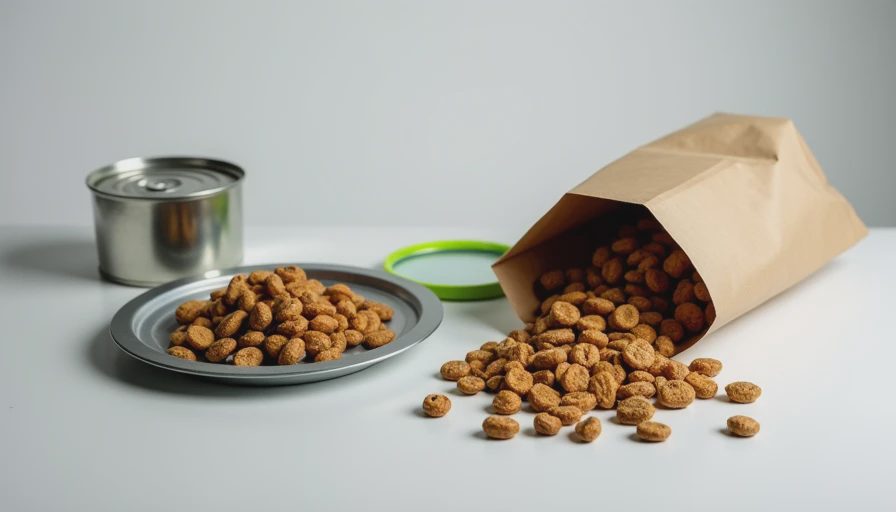
The Question That Never Goes Away
“Is wet better than dry?”
“Is kibble junk?”
“Should I just feed canned?”
I get some version of this almost every week. The answers people bring with them are usually absolute: one format is species-appropriate and the other is processed garbage, or one is convenient and the other is a scam.
I have formulated both. I have sat through the cost analyses, the digestibility trials, the palatability panels, and the shelf-life meetings for each. The real trade-offs are more interesting than the slogans. This post lays them out so you can choose with clear eyes instead of marketing residue.
Moisture: The Most Obvious Difference
Wet food is typically 70–85 % moisture. Dry food is usually 6–12 % moisture. That single fact drives most of the downstream differences.
Higher moisture means lower calorie density by weight or volume. A dog has to eat a larger volume of wet food to obtain the same calories. For some dogs this is an advantage—greater meal volume can improve satiety during weight loss. For other dogs it is a disadvantage—large volumes can be impractical for big dogs or for owners who travel.
The water itself is useful. Dogs eating wet food obtain a meaningful portion of their daily water intake from the food. This can support urinary-tract health and overall hydration, especially in dogs that drink sparingly. Dry food relies more heavily on the dog drinking free water.
Neither format is inherently superior on this point; the value depends on the individual dog’s drinking habits and medical needs.
Processing and Nutrient Delivery
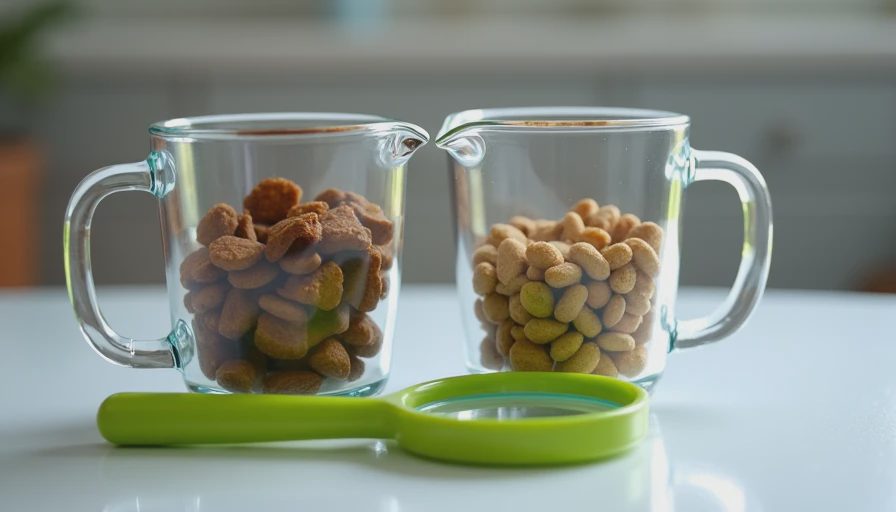
Dry food is usually extruded or baked at high temperature. Wet food is typically sealed in cans, trays, or pouches and then retorted (heat-sterilized). Both processes affect nutrients.
Extrusion can improve starch digestibility and create the familiar kibble texture. It can also reduce the activity of certain heat-sensitive vitamins, which is why manufacturers add vitamin premixes that account for processing losses. Retorting achieves commercial sterility and a long ambient shelf life, but the longer heat exposure can affect texture and some nutrient forms differently.
In the formulation software the two formats require different nutrient targets and different ingredient choices. A protein source that works well in a can may not expand properly in an extruder, and vice versa. Fat levels, fiber types, and binding ingredients are adjusted accordingly. The finished nutrient profiles can be made equivalent on a dry-matter basis, but the route to get there is not identical.
Digestibility and Stool Quality
Head-to-head digestibility studies show that both well-formulated wet and well-formulated dry foods can achieve high digestibility. Some studies find modestly higher apparent protein or fat digestibility for certain wet formulas; others find no meaningful difference once dry-matter corrections are applied.
Stool volume and quality are influenced more by fiber type and overall digestibility than by the wet/dry format itself. A poorly formulated wet food can produce loose stools; a poorly formulated dry food can produce large, dry stools. The format is not the deciding variable—the specific recipe is.
Dental Claims and the Reality Check
Dry food is frequently marketed as better for dental health because the kibble “scrapes” the teeth. Controlled studies show that any mechanical benefit is modest at best and highly dependent on kibble size, shape, and texture. Most dental benefit attributed to dry food is overstated. Actual dental disease prevention still relies far more on mechanical cleaning (brushing, dental diets with proven VOHC claims, professional care) than on the simple choice of dry versus wet.
Wet food does not automatically cause dental disease, either. The absence of mechanical abrasion is real, but it is only one factor among many.
Cost, Convenience, and Storage
On a per-calorie basis, dry food is almost always less expensive. It is also lighter, easier to store, and simpler to measure for precise calorie control. Wet food is heavier, bulkier, more expensive per calorie, and once opened has a short refrigerator life.
For multi-dog households, travel, or owners who need exact portion control, dry food has clear practical advantages. For dogs that refuse dry food, need higher moisture intake, or require very low calorie density, wet food solves problems that dry food cannot.
Many owners end up feeding a mix. That is a rational solution, not a compromise of principle.
Palatability and the Picky-Dog Factor
Wet food generally wins palatability panels. The aroma and texture are more attractive to most dogs. This is useful when appetite is compromised (senior dogs, medical recovery, certain chronic diseases). It can be a disadvantage when an owner needs to reduce intake for weight control—the dog may lobby harder for more food.
Dry food is more stable and less aromatic once the bag is open, which some households prefer.
What I Actually Recommend in Practice
I do not start with a format preference. I start with the dog’s calorie needs, medical constraints, drinking behavior, dental status, household logistics, and budget.
If the dog needs higher moisture intake or has a chronically low thirst drive, wet food or moistened dry food moves up the list.
If precise calorie control and cost matter most, dry food usually wins.
If the dog is a difficult eater during illness, wet food is often the practical tool.
If dental health is a primary concern, I look for diets with actual VOHC acceptance rather than assuming dry equals clean teeth.
If the household can manage both, a mixed feeding plan frequently gives the best combination of benefits.
I have formulated excellent versions of each. I have also seen mediocre versions of each. The format does not determine quality. The formulation and the manufacturing controls do.
The Trade-Off Summary
Wet food brings higher moisture, generally higher palatability, lower calorie density by volume, higher cost per calorie, and more demanding storage.
Dry food brings lower moisture, excellent storage stability, lower cost per calorie, easier portion control, and only modest mechanical dental benefit.
Neither is universally better. The right choice is the one that matches the dog’s physiology and the owner’s real life.
Flip both packages. Compare the dry-matter nutrient profiles, the AAFCO statements, and the practical constraints of your household. Then decide. The marketing noise on both sides is louder than the actual nutritional differences.



No notes yet — write the first one.