You are standing in the pet food aisle, comparing two bags that both promise health, quality, and happy mealtimes. One says “natural.” Another features a picture of fresh chicken. What do FDA pet food regulations actually require, and what is left to marketing? The short answer is useful: pet food sold in the United States must be safe, made from permitted ingredients, and labeled truthfully. But those rules do not tell you which product is best for every dog or cat.
I want to make that distinction clear. Regulation is a safety floor, not a personalized nutrition plan. Flip the bag. Read the panel.
What FDA pet food regulations cover
The Food and Drug Administration regulates animal food through its Center for Veterinary Medicine. Under the Federal Food, Drug, and Cosmetic Act, pet food cannot be adulterated or misbranded. In everyday language, it should not contain harmful contamination, unsafe substances, or a label that gives a materially false impression.
FDA also oversees ingredients. Some substances are recognized as safe for their intended use, while others must go through an approval process. Color additives generally require authorization. Certain ingredients can be used through an accepted safety pathway, including a conclusion by qualified experts or a defined regulatory status. This is why “chemical-sounding” does not automatically mean dangerous, and “natural” does not automatically mean nutritious.
The agency can inspect facilities, investigate complaints, work with manufacturers on recalls, and take action when a product violates the law. It does not preapprove every bag of kibble or can of food before it reaches a store. That point matters: a product being legally sold is not the same as FDA endorsing it for your individual pet.

Who sets nutritional standards?
FDA rules provide the federal framework, but states also play a major role. Many states use regulations based on standards developed by the Association of American Feed Control Officials, commonly called AAFCO. AAFCO is not a federal regulator and does not approve products. Instead, it publishes model language and nutritional profiles that states may adopt.
This arrangement explains why you may see an AAFCO nutritional adequacy statement on a label. A food might say it is complete and balanced for adult maintenance, growth and reproduction, or all life stages. That statement means the product is intended to provide required nutrients when fed as directed for the listed life stage. It does not mean the food is ideal for every puppy, senior cat, overweight Labrador, or pet with kidney disease.
A product can meet a recognized nutrient profile and still differ substantially in calorie density, digestibility, texture, and ingredient sourcing. Those details become important when your veterinarian is managing vomiting, food allergies, diabetes, urinary disease, or weight gain.
How to read the label without getting distracted
FDA pet food regulations require key label information, but the front of the package is designed to attract attention. Start with the back or side panel instead.
The product name can tell you something about the amount of a named ingredient, but naming conventions are technical. “Chicken dog food,” “dog food with chicken,” and “chicken-flavored dog food” do not communicate the same formulation. The ingredient list is arranged by weight before processing, so ingredients containing substantial water can appear higher than their dry-matter contribution might suggest.
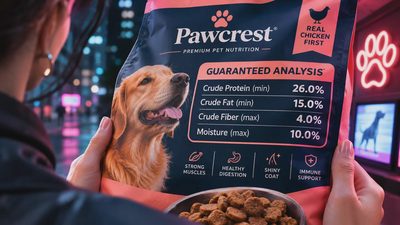
Next, find the guaranteed analysis. It lists minimum crude protein and crude fat and maximum crude fiber and moisture. These numbers are useful, but they are not a complete nutrient comparison. A dry food with 25% protein and a canned food with 10% protein cannot be compared fairly until moisture is accounted for. Calories per cup, can, or kilogram are often more practical for managing body weight.
Here is what the panel says — and what it does not. It can tell you the listed ingredients, guaranteed nutrient minimums or maximums, feeding directions, manufacturer information, and intended life stage. It cannot tell you whether your cat will tolerate the recipe, whether a dramatic front-panel claim is meaningful, or whether a food suits a diagnosed condition.
Safety claims, recalls, and complaints
FDA pet food regulations address contamination and misbranding, but no manufacturing system eliminates every risk. Recalls can involve pathogens, excess or deficient nutrients, foreign material, undeclared allergens, or other problems. A recall is not proof that an entire company is careless; it is a reason to identify the affected product and follow the instructions promptly.
Keep the original package, lot number, UPC, and expiration date until the food is used. If your pet becomes ill after eating a product, contact your veterinarian first, particularly for repeated vomiting, weakness, neurologic signs, bloody diarrhea, or refusal to eat. You can also report suspected problems through FDA channels. A clear report includes the product name, lot information, purchase date, symptoms, and veterinary findings.
Do not rely on a social media screenshot as your only recall source. Confirm the product, lot code, and date against an official notice or the manufacturer’s current information. If food is recalled, stop feeding the affected lot and ask your veterinary team how to transition safely, especially if your pet eats a therapeutic diet.

What “natural,” “premium,” and “human-grade” mean
Marketing words deserve translation rather than panic. “Natural” can have a defined regulatory meaning related to ingredients derived from plant, animal, or mined sources with limited chemical alteration, but it does not mean the food is free of all processed ingredients or automatically superior. “Premium” is largely a marketing term and does not guarantee better nutrition.
“Human-grade” has more specific expectations than a casual phrase on a bag. It generally concerns ingredients being fit for human consumption and the product being manufactured under appropriate human-food requirements. Even then, the claim does not answer whether the recipe is complete and balanced for your pet.
FDA pet food regulations also do not require a manufacturer to make every formulation detail public. Proprietary recipes, supplier information, and quality-control procedures may not appear on the label. If a company makes a safety or nutrition claim, look for clear supporting information rather than a parade of vague words such as clean, ancestral, or instinctive.
A practical store-aisle checklist
Before buying, identify your pet’s life stage and any medical needs. Then check for a nutritional adequacy statement appropriate to that stage. Compare calories per serving, not just the percentage of protein on the package. Confirm the feeding directions are realistic for your pet’s weight, activity, and body condition.
Look for a manufacturer that can answer basic questions about formulation, quality control, and who oversees nutrition. A company does not need to publish a celebrity endorsement; it should be able to explain how it checks ingredients and finished products. If a recipe is marketed for a medical condition, ask your veterinarian whether it is an actual therapeutic diet or simply a conventional food using disease-related language.
For a healthy adult dog or cat, a complete-and-balanced commercial food from a transparent manufacturer can be a sensible choice across many price points. For a growing puppy, kitten, pregnant pet, or animal with disease, the margin for guesswork is smaller. Your veterinarian or a board-certified veterinary nutritionist can help interpret the label in context.
The most useful lesson from FDA pet food regulations is not that one ingredient list wins forever. It is that safety rules, nutritional adequacy, and individual suitability are three separate questions. Ask all three before filling the bowl. Today, take the package you already use, find its adequacy statement and calorie information, and save a photo of the lot code. Then flip the bag and read the panel.




No notes yet — write the first one.