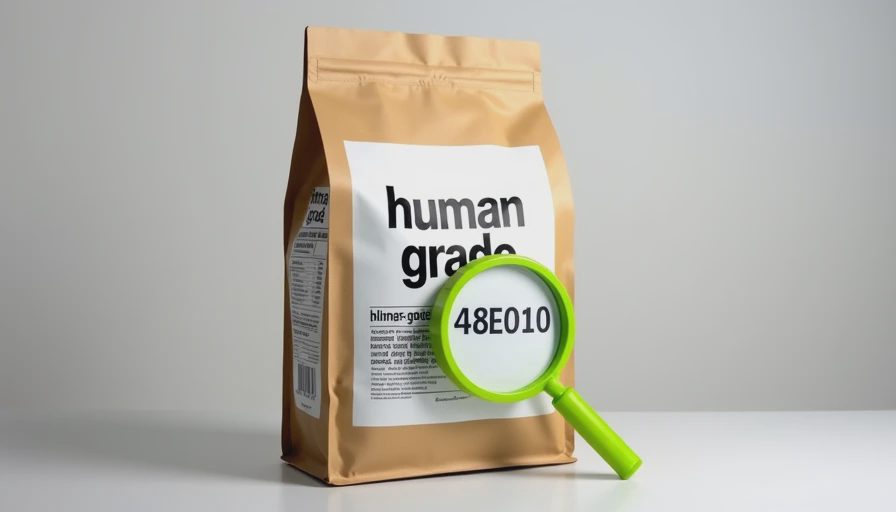
The Phrase That Sounds Like a Guarantee
“Human-grade.”
It appears on bags, cans, and freeze-dried packages in larger type than almost any other claim. It suggests that the food is made from the same ingredients, in the same facilities, under the same standards as the food you would eat yourself. For many owners it has become shorthand for “safer” or “higher quality.”
I have formulated diets that carried the claim and diets that did not. The difference is real, but it is narrower and more technical than the marketing implies. This post walks through what the term actually requires, what it leaves unsaid, and how I treat it when I read a panel.
The Regulatory Definition (Not the Marketing One)
In the United States the phrase “human-grade” is not a casual descriptor. According to guidance used by AAFCO and state feed control officials, a pet food may be labeled human-grade only if:
Every ingredient in the product is suitable for human consumption and is handled, processed, and stored in a manner consistent with human-food standards.
The entire product (not just selected ingredients) is manufactured in a facility that follows human-food regulations, typically under FDA human-food current Good Manufacturing Practices.
The product is stored and transported under conditions appropriate for human food.
If any single ingredient or process step fails those criteria, the human-grade claim cannot be used for the finished product. This is stricter than many owners realize. It is also stricter than the rules that govern ordinary pet food, which may legally use ingredients and facilities that meet animal-feed standards rather than human-food standards.
So the claim is not empty. It imposes real constraints on sourcing, processing, and documentation.

What the Claim Does Not Mean
Here is where the marketing haze usually begins.
Human-grade does not mean the food is nutritionally superior by default. A human-grade diet can still be poorly balanced, low in essential nutrients, or inappropriately high in fat or phosphorus for a particular dog. The claim speaks to the regulatory status of the ingredients and the facility, not to the adequacy of the nutrient profile for dogs or cats.
It does not mean the food is “safer” in every microbiological sense. Human-food facilities have their own pathogen risks and recall histories. Properly processed conventional pet food that undergoes extrusion or retort sterilization can achieve very low pathogen levels. The human-grade process is different; it is not automatically more sterile.
It does not mean every ingredient is something you would personally choose to eat for dinner. “Suitable for human consumption” includes many items that are legal and edible but not typically sold at the retail meat counter. The standard is regulatory fitness, not culinary prestige.
It does not guarantee better digestibility, better amino-acid profiles, or better clinical outcomes. Those attributes have to be measured separately.
Why Companies Pursue the Claim
From a formulator’s perspective the human-grade route has clear costs. Ingredient streams are more expensive. Facility requirements are higher. Documentation and audit burdens increase. The decision to pursue the claim is therefore usually driven by brand positioning: a segment of owners will pay a premium for the reassurance the phrase provides.
That reassurance is not imaginary. Knowing that the entire supply chain is held to human-food standards is meaningful information. It simply is not the same thing as proof that the finished diet is the best nutritional choice for a given animal.
How I Actually Read the Claim on a Panel
When I see “human-grade” I treat it as one useful data point among several:
Does the product also carry a clear AAFCO nutritional adequacy statement for the intended life stage?
Is there a typical nutrient analysis or other transparency beyond the minimum guaranteed analysis?
Does the company provide any digestibility or feeding-trial information?
Does the overall nutrient profile match the dog’s actual needs (calories, phosphorus, protein quality, etc.)?
If the answers to those questions are solid, the human-grade status is a positive additional feature. If the nutrient profile is inappropriate for the dog in front of me, the human-grade claim does not rescue it.
I have recommended human-grade diets when they fit the clinical and practical requirements. I have also recommended conventional diets that met the same requirements at lower cost and with excellent track records. The deciding factors were the numbers and the dog, not the presence or absence of the phrase.
Common Misunderstandings I Hear
“If it’s human-grade, I can feed it to myself.”
Technically the ingredients and process meet human-food standards, but the finished product is still formulated for dogs. The mineral levels, vitamin fortification, and texture are not designed for human nutritional needs or preferences.
“Human-grade means no by-products.”
Not necessarily. Certain organ meats are fully edible and used in human food systems. Their presence or absence is a separate formulation choice.
“Everything else is low-quality.”
Ordinary pet-food regulations still require ingredients to be safe and suitable for animal feed. Many excellent diets never pursue the human-grade claim because of cost or facility limitations, not because the ingredients are substandard for dogs.
Practical Takeaway for the Aisle
The next time you see “human-grade” in large letters, flip the bag and finish the job.
Check the AAFCO statement. Look at the guaranteed analysis. Ask whether the company publishes more detailed nutrient data. Match the overall profile to your dog’s life stage, health status, and calorie needs.
The human-grade claim tells you something real about the regulatory pathway the product followed. It does not tell you whether the diet is complete, balanced, digestible, or appropriate for the animal who will eat it. Those answers still live in the rest of the panel and in the dog’s response over time.
Read the whole label. The useful information is there. It is just not confined to the two words on the front.




No notes yet — write the first one.