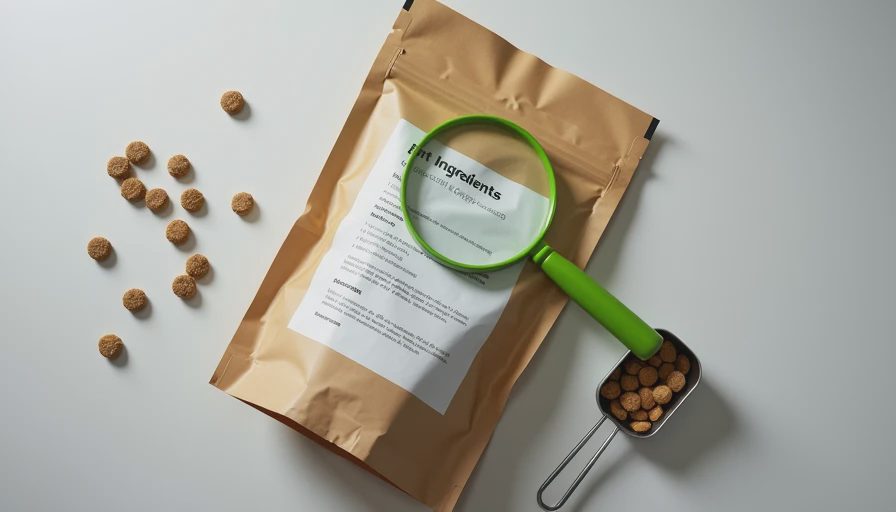
The Rule Almost Everyone Knows
“Look at the first five ingredients. That’s what the food is really made of.”
I hear this sentence in exam rooms, in online comments, and from well-meaning store staff. It is repeated so often that it has acquired the status of common knowledge. It is also one of the most reliable ways to misread a pet-food label.
I used to write those labels. I know how the order is determined, how moisture skews the ranking, and why a food that lists “chicken, chicken meal, rice…” can be nutritionally almost identical to one that lists “chicken meal, rice, chicken…” after the water is accounted for. The first-five rule treats the ingredient list as a popularity contest when it is actually a weight ranking of ingredients in their pre-processing state.
Let’s unpack why that distinction matters.
How the Ingredient List Is Built
By regulation, ingredients must be listed in descending order by weight before the product is processed and cooked. That means the ranking reflects the weight of each ingredient as it enters the mixer, not the weight of the final contribution to the dry matter of the finished kibble or can.
Fresh chicken is roughly 70% water. Chicken meal has already had most of that water removed and is typically 6–10% moisture. So one pound of fresh chicken contributes far less actual protein and amino acids to the finished food than one pound of chicken meal.
When a company puts “chicken” first, it is often telling the truth about weight at the time of mixing. It is not necessarily telling you that chicken muscle tissue is the dominant dry-matter ingredient in the bag you carry home.
This is not a loophole. It is basic food technology. The same principle applies to any fresh or frozen meat, fish, or organ listed ahead of its rendered meal counterpart.
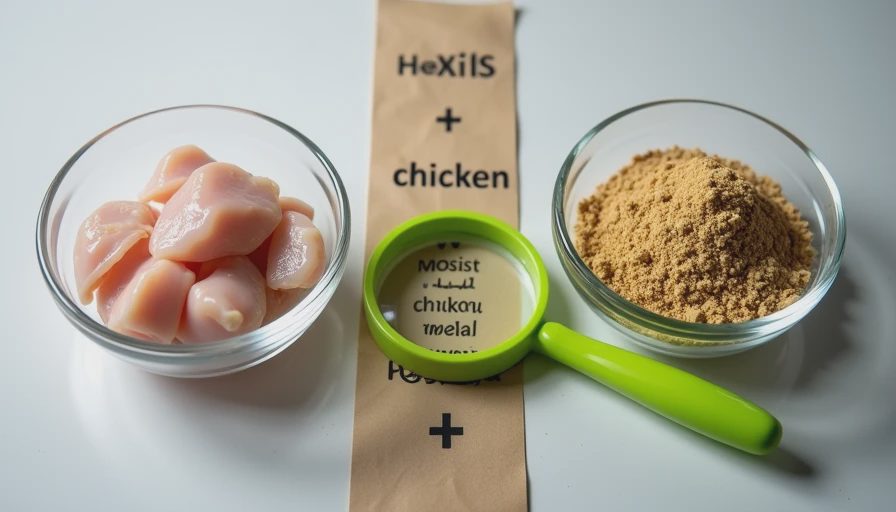
A Simple Side-by-Side Reality Check
Imagine two formulas that deliver essentially the same amount of chicken-derived protein:
Formula A
Chicken, chicken meal, brown rice, barley, chicken fat…
Formula B
Chicken meal, brown rice, barley, chicken fat, chicken…
On the label, Formula A looks more “meat-first.” On a dry-matter basis after processing, the two can be nearly identical in amino-acid contribution from chicken. The difference is largely optical and driven by the water weight of the fresh chicken in Formula A.
I have formulated both styles. The decision often came down to supply-chain logistics, cost of the fresh versus the meal stream that week, and how the marketing team wanted the panel to read—not to a fundamental nutritional superiority of one order over the other.
What the First Five Actually Can Tell You
The list is not useless. It still gives useful directional information:
Named animal proteins (chicken, beef, lamb, fish, and their meals) appearing early suggest the formula is built around animal rather than plant protein sources.
A long string of different sugar sources or split ingredients (multiple ways of listing the same grain or fiber) can be a sign that the company is trying to keep any single plant ingredient from climbing higher in the order.
The presence of a named fat source early (chicken fat, salmon oil) tells you something about energy density and fatty-acid contribution.
What the first five cannot reliably tell you is the precise ranking of dry-matter contribution or the final amino-acid profile. For that you need the guaranteed analysis, a typical nutrient analysis if the company publishes one, and ideally digestibility or feeding-trial data.
The Marketing Incentive Problem
Companies know that many owners have been trained to scan only the first five lines. That knowledge shapes formulation and labeling choices. Fresh meat may be added primarily to secure the top spot on the list even when the majority of the animal-protein contribution still comes from meal. Split plant ingredients can keep any single carbohydrate from looking dominant.
None of this is illegal. All of it is predictable once you understand that the ranking is by pre-processing weight and that consumer attention is concentrated on the first few lines.
The result is an ingredient list that is technically accurate and simultaneously easy to misinterpret if you apply the popular first-five rule without accounting for moisture.
A Better Way to Read the Same Panel
When I teach owners to read labels, I ask them to do three things instead of stopping at ingredient number five:
Read the full AAFCO nutritional adequacy statement first. Life stage and the basis of the claim (formulation versus feeding trial) matter more than the order of the first few ingredients.
Look at the guaranteed analysis and convert key values to dry-matter basis if comparing wet and dry foods. Protein and fat percentages become far more meaningful once moisture is removed from the comparison.
Treat the ingredient list as supporting context rather than the primary ranking system. Ask whether the animal-protein sources are named and consistent, not whether one form of chicken beat another form of chicken by a few percentage points of water weight.
This approach takes a little longer the first time. After that it becomes faster than arguing about whether “chicken” or “chicken meal” deserved the top spot.
What I Actually Did When I Formulated
In the lab we cared about the finished nutrient profile, the digestibility numbers, the ash content, and whether the formula stayed inside the target ranges for calcium, phosphorus, and essential amino acids after processing. The order of the first five ingredients was a downstream consequence of those decisions and of the moisture content of the raw materials we happened to be using that production run.
I never once sat in a formulation meeting and said, “We need to get fresh chicken into the number-one position so the label looks better.” I did sit in meetings where we discussed how the final label would be perceived. Those are not the same thing.
The nutritional reality lived in the laboratory analysis and the feeding trials. The ingredient list was the regulated way of disclosing what went into the mixer.
Practical Takeaway for the Aisle
The next time someone tells you to judge a food by its first five ingredients, pause. Ask what happens to that ranking after the water is removed. Then flip the bag the rest of the way and look at the guaranteed analysis and the AAFCO statement.
Those sections are harder to game with moisture weight. They are also closer to the information that actually determines whether the food can support your dog.
The first five ingredients are not a lie in the legal sense. They are a ranking by pre-processing weight. Treating them as a simple popularity contest of “what the food is made of” is the part that was taught to you incorrectly.
Read the whole panel. The useful information is still there. It just is not concentrated in the first five lines the way most people have been told.





No notes yet — write the first one.