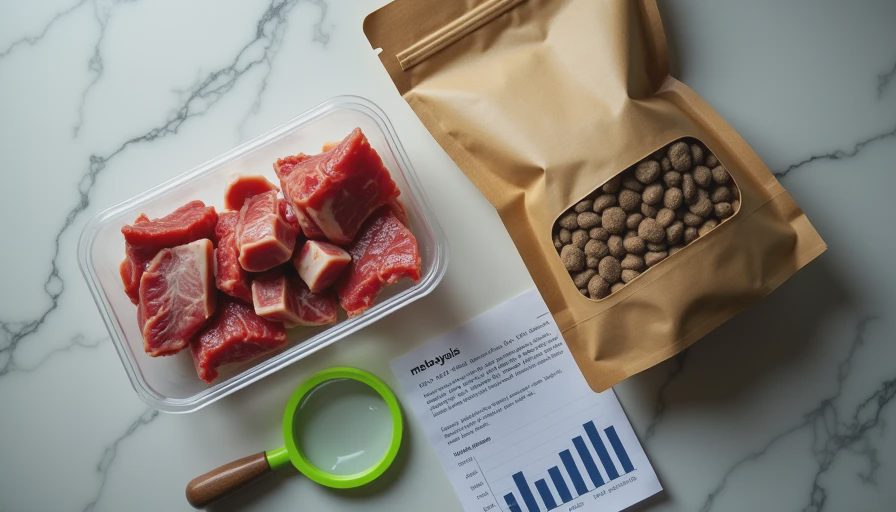
The Question I Get Asked in Every Exam Room
“Should I switch to raw?”
It usually arrives right after the owner has scrolled through three different Facebook groups and one very confident TikTok veterinarian. Sometimes the dog is sitting there looking perfectly healthy. Sometimes the dog has chronic soft stool or itchy skin and the owner is desperate for a fix that doesn’t involve another prescription diet.
I used to give the long, careful answer. Now I start with a shorter one: “I read the meta-analyses. Let’s talk about what they actually found.”
That is what this post is for.
I went back through every systematic review and meta-analysis on raw or BARF-style diets for dogs and cats that I could find published from 2020 onward. I am not claiming this is the final word on the subject. Science does not work that way. What I am claiming is that if you are going to make a feeding decision based on “the evidence,” you should at least know what the higher-level evidence currently looks like.
What Counts as Evidence Here
A single feeding trial can tell you something useful about one formula under controlled conditions. A well-done meta-analysis tries to pull those trials (and observational studies) together, weigh their quality, and ask whether the overall signal is real or just noise.
Since 2020 the published meta-analyses and systematic reviews on raw diets have focused on a handful of recurring questions:
Nutritional adequacy and the risk of imbalances
Pathogen contamination and public-health risk
Digestibility and fecal quality
Effects on dental health, skin, and general clinical outcomes
Owner-reported benefits versus measured outcomes
I am going to walk through the main findings without the academic throat-clearing. Where the data are thin, I will say so.
Nutritional Adequacy: The Quiet Problem
One of the more consistent findings across recent reviews is that a surprising number of commercially available and home-prepared raw diets fail to meet established nutrient profiles when actually analyzed.
This is not a theoretical risk. Multiple analyses since 2020 have documented deficiencies or excesses in calcium, phosphorus, vitamin D, vitamin E, and certain trace minerals. The problem is worse in recipes that owners assemble themselves from internet sources, but it appears even in some commercial raw products that claim to be complete and balanced.
The takeaway is straightforward. “Raw” is not a nutritional guarantee. Formulation and quality control still matter. If a company cannot show you a full nutrient analysis (not just a guaranteed analysis on the label) and evidence that the product meets AAFCO or FEDIAF profiles through analysis or feeding trials, you are taking a nutritional risk that has nothing to do with cooking temperature.
Pathogens: The Part That Keeps Showing Up

This is the finding that refuses to go away.
Systematic reviews continue to document higher rates of Salmonella, Listeria, and other pathogens in raw pet foods compared with heat-processed commercial diets. The risk is not only to the pet. Household transmission to humans—especially children, elderly people, and immunocompromised individuals—is documented in the literature.
Some newer papers have looked at high-pressure processing and other interventions. Those methods reduce pathogen load, but they do not eliminate it in every case, and not every commercial raw product uses them. Freezing does not reliably kill these organisms either.
I am not saying every raw-fed household will experience an outbreak. I am saying the risk is measurable, repeatedly documented, and higher than with properly processed commercial food. If someone in your home is at elevated risk for foodborne illness, that data point belongs in the decision.
Digestibility and the Stool Question
Here the picture is more mixed and, frankly, more interesting.
Several studies and at least one recent meta-analysis have found that certain raw diets can produce higher apparent digestibility of protein and fat, and firmer stools, compared with some extruded kibbles. That finding is real. It does not, however, apply to every raw product or every dog. Digestibility depends heavily on the specific ingredients, the particle size, and the individual animal’s gastrointestinal physiology.
Owners often report “better stools” after switching to raw. Sometimes the laboratory data support that observation. Sometimes the improvement is simply the result of removing a poorly tolerated carbohydrate source or a high level of fermentable fiber that was in the previous diet. Correlation is not the same as proof that “raw” itself is the active ingredient.
Clinical Outcomes: Where the Evidence Thins Out
This is the section that frustrates both sides of the debate.
Claims that raw diets improve dental health, reduce allergy symptoms, or extend lifespan are common in marketing and online discussion. High-quality evidence supporting those claims remains limited. Most of the positive reports are still owner surveys or small, uncontrolled case series. When controlled trials exist, the results are often modest or confounded by other variables (different protein sources, different fat levels, different overall caloric density).
One recent systematic review noted that while some biomarkers move in favorable directions on certain raw diets, clinical endpoints that matter to owners—itch scores, dental disease progression, longevity—are still under-studied.
That does not mean the benefits are imaginary. It means we do not yet have the kind of evidence that would let me look an owner in the eye and say, “The data clearly support switching for this reason.”
What I Tell Owners in Practice
After I have walked through the above, the conversation usually lands in one of three places.
The dog is healthy, the household has no high-risk people, and the owner is using a commercial raw product with a documented complete nutrient profile and pathogen-reduction steps. In that case I document the choice, discuss monitoring, and move on. I do not fight the decision.
The dog has a medical condition that requires precise nutrient control (kidney disease, certain uroliths, severe pancreatitis history). In those cases I am much more cautious. Many raw products cannot guarantee the tight nutrient ranges we need, and the pathogen risk is harder to justify.
The owner is preparing the diet at home from a recipe found online. This is where I spend the most time. Most of those recipes are incomplete. I either help them find a properly formulated recipe from a board-certified nutritionist or steer them toward a commercial option that has been analyzed.
I never tell an owner that raw is “toxic” or that kibble is “poison.” Both statements are marketing, just aimed at different audiences. The evidence is more nuanced than either slogan.
Practical Next Steps If You Are Considering Raw
Ask the manufacturer for a full typical nutrient analysis, not just the guaranteed analysis on the bag.
Ask what pathogen-reduction methods they use and whether they publish testing data.
If you are feeding a home-prepared raw diet, have the recipe evaluated by a veterinary nutritionist. The cost of a consult is lower than the cost of treating a deficiency or a household Salmonella case.
Monitor body weight, stool quality, and any clinical signs. “My dog seems happier” is useful information, but it is not a complete nutritional assessment.
Keep the same hygiene standards you would use for handling raw meat for human consumption. Because that is exactly what you are doing.
Where the Evidence Stands in 2026
The meta-analyses published since 2020 have not crowned a winner. They have clarified the trade-offs.
Raw diets can offer high digestibility and, when properly formulated, complete nutrition. They also carry a documented higher risk of bacterial contamination and, in too many commercial and home-prepared versions, incomplete nutrient profiles. Clinical benefits beyond digestibility remain incompletely proven.
That is not a satisfying slogan for either side of the internet argument. It is, however, an accurate summary of the higher-level evidence we currently have.
If your dog is thriving on a well-formulated raw diet and your household risk tolerance matches the data, you do not need my permission to continue. If you are switching because a stranger on the internet promised it would fix everything, you deserve better information than that.
Flip the bag—or the package insert—and look at what is actually being claimed. Then decide with your eyes open.
That is the only way this debate gets any clearer.





No notes yet — write the first one.